Most people want the marketing channel that pays this week.
I’m betting on the one that pays in a year.
Not because I’m patient. I’m really not. I’m betting on it because almost nobody else will wait that long. That’s the whole edge.
Distribution is the whole game
You can build the best product in your market and die quiet. Nobody finds it. That’s the part founders forget. The product isn’t the hard bit anymore. Getting seen is.
So the real question isn’t “what should I build.” It’s “how will people find me.” That’s distribution. And you only get a few real channels to pick from.
Ads. You pay, you show up. Stop paying, you vanish the same day.
Word of mouth. Lovely, but you can’t turn it on.
Search. Someone types a question, your page answers it, they show up. For free. Forever, if you keep ranking.
Most people pick ads, because ads pay today. I get it. But you’re renting attention. The second the card stops, so does the traffic. You never own anything.
I went the other way. I bet on search. And once you decide to bet on search, the question becomes which AI SEO tools actually make the bet practical.
So here’s the bet
Search is the one channel that’s three things at once. It’s basically free. It builds up over time. And it can turn into a real revenue channel on its own, no ad budget needed.
Here’s the way I think about it. Ads are renting. Search is buying a house.
Rent gets you a roof tonight. Fast. But you pay again next month, and the month after, forever. Stop, and you’re out on the street.
Buying is slow and it hurts up front. But one day the place is yours. A blog post is the same. You write it once. It keeps pulling people in for years, for nothing. You already paid. It just keeps working.
That’s the bet in one line. Do the slow, boring, free thing now. Own the traffic later.
The math, on a napkin
I don’t want this to sound like a vibe. So let me show you the actual math I ran for Kirro, the A/B testing tool I built. Plain numbers, on a napkin.
The bet, on a napkin:

~100 visits a month today
  grows ~10x as the posts age and rank   →  ~1,000 / month
  ~2 in 100 start a free trial            →  ~20 trials / month
  ~1 in 10 of those pay                   →  a couple of customers a month
  stack that up over a year               →  ~32 paying customers
  times 99 euros a month                  →  ~3,000 / month  (~36k a year)

≈ a real revenue channel, from posts that are already written.

(This is the plan. None of it is in the bank yet.)
Read that last line again, because it matters. This is a plan, not a result. I’m showing you my homework, not a win.
Roughly 3,000 euros a month. About 36,000 a year. From a blog, for free. And the part that holds whatever you sell: swap in your own price and your own conversion rate. The shape doesn’t change. Once the posts are written and ranking, that traffic mostly shows up on its own.
If you want the longer story of how I actually write and ship all these posts with AI, that’s its own piece. This one’s about why I bother with something this slow.
Where I actually am right now
Time for the honest part. This is my real Search Console. No cropping the bad bits.
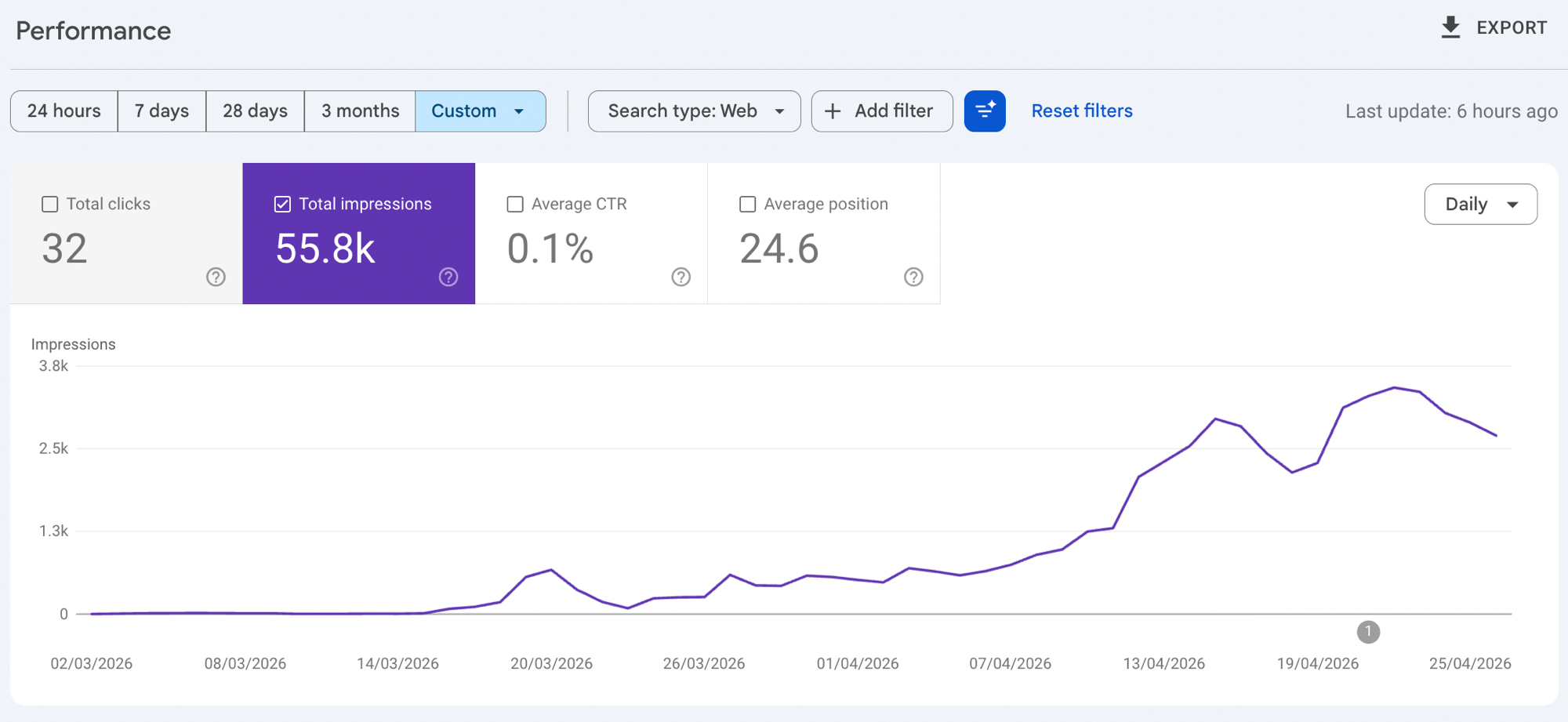
That climbing line is impressions. It’s how often Google showed my pages to someone. In about eight weeks it went from basically zero to 55,800. The line is going up and to the right, fast.
That’s the first signal you ever get in SEO. Not clicks. Not money. Just Google starting to show you to people. It comes months before anything you can spend.
Now the part that keeps me honest. Same window, two ways.
| Real today | The plan | |
|---|---|---|
| Times I showed up in search | 55,800 in 8 weeks, climbing | keeps climbing |
| Average spot on the page | ~25, pulling up toward 15 | top 10 on buying terms |
| Actual clicks | 32 | they follow the spot (my bet) |
| Visits a month | ~100 | ~1,000 |
| Paying customers | 0 | ~32 |
| Money in the door | 0 euros | ~3,000 / month |
Yeah. Thirty-two clicks. Zero customers. Zero euros.
Now, those impressions aren’t for junk. Look at what people are actually searching when my pages come up.
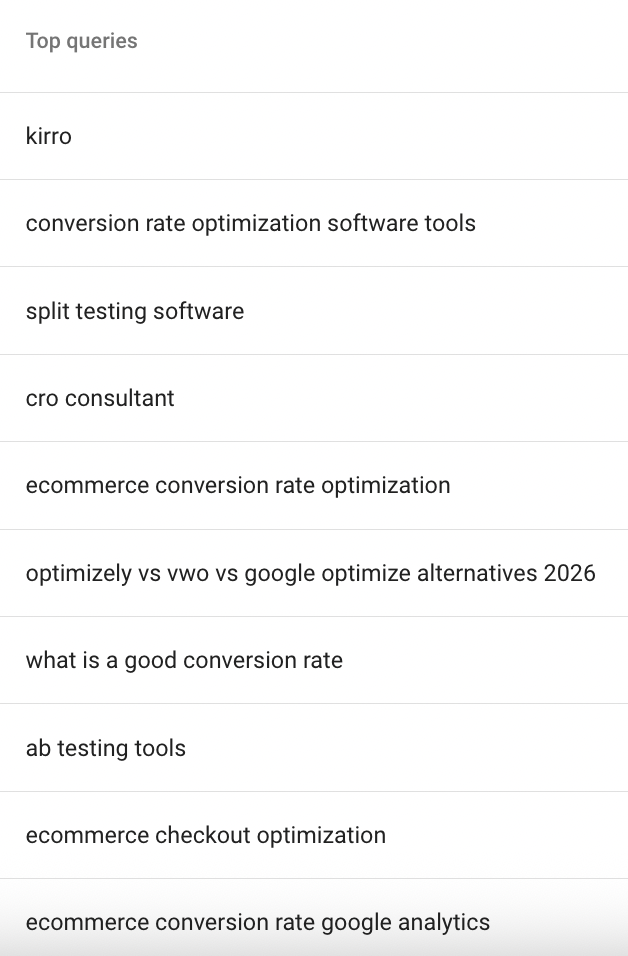
Split-testing software. A/B testing tools. Someone to help lift conversion. These are people trying to buy roughly what the product does, not folks reading for fun. That’s the kind of traffic worth waiting for.
So why am I not panicking about the 32 clicks? Two reasons, and the next two sections are both of them.
(Quick aside: 32 clicks in Search Console, but my analytics says about 100 visits a month. Those two numbers should match and they don’t, not even close. That gap is a whole other post. Short version: Search Console badly under-counts when you’re small.)
Why I think it keeps going up
The magic word is compounding, and it’s the most boring word in finance for a reason.
A post I wrote in March is still ranking in June. It didn’t stop. Meanwhile I added more posts. Each new one helps the others. Google trusts the site a little more each month. The whole thing pushes itself up.
You can see it starting. This is the average spot my pages sit in over the same weeks.
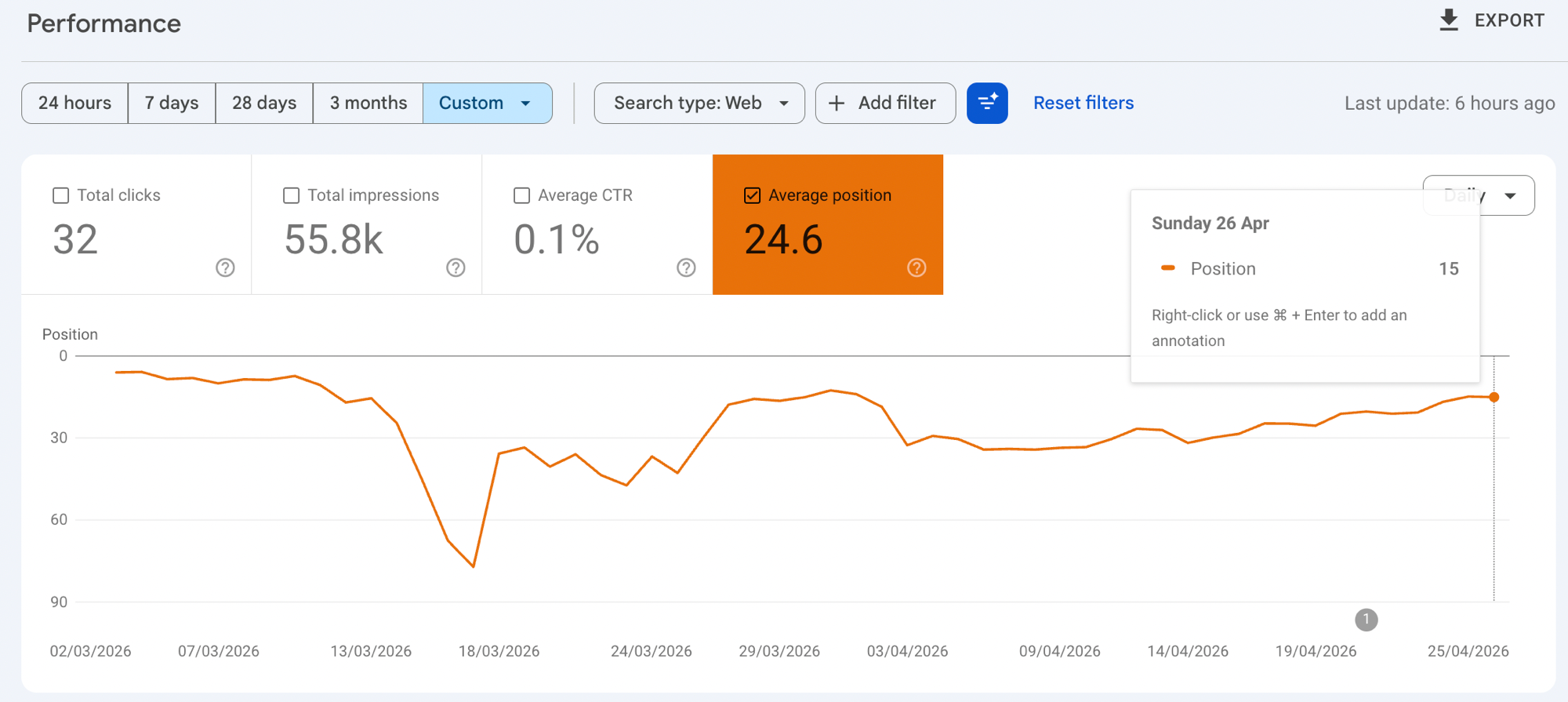
I started around spot 25. Page three. Now I’m pulling up toward 15. Page two, knocking on page one.
And that’s the whole game. Almost nobody clicks a result on page three. On page one, lots of people do. So as those pages climb the last few spots, the clicks don’t grow in a straight line. They jump.
That’s the bet under the bet: the spots are climbing, so the clicks should follow. I’ll be straight with you, that last part is still an assumption. I haven’t banked it yet. But the order it happens in, impressions, then spots, then clicks, that part is real and it’s already moving.
Let me put a rough number on the compounding. My traffic is picking up: the last week came in about 3 times faster than my three-month average. Say it just grows 30% a month from here. Start at 160 visits, run it seven months, and you land near 1,000 a month by December. That’s the boring math doing the work. No viral moment needed. Just a small monthly bump, stacked.
If you’d rather have an engine like this built into your team than wire it up yourself over a year, that’s what I do.
The slow part is the best part
Here’s the second reason I’m calm. The slowness isn’t a bug I’m putting up with. It’s the reason this works at all.
SEO takes 6 to 12 months to pay off. Most people who hear that quit. They try it for three months, see 32 clicks, and go back to ads. I don’t blame them. It feels like nothing is happening.
But think about what that means. The slow lane is nearly empty. Everyone who can’t wait already left. So the only people I’m really up against are the few who also decided to wait. That’s a much shorter list.
The harder and more boring the play, the less competition you have. Slow is a filter. It’s doing me a favour.
And it does pay off, later, hard. A few real examples I keep in mind:
- Plausible, an analytics tool, had one blog post take off and go from 400 to 10,000 dollars a month in ten months. Search became their biggest channel, but only much later, after the grind.
- Tally, a form builder, is past 150,000 a month now. Early on they barely touched link building. They just kept showing up.
- Bannerbear got to about 50,000 a month the same way. Patience, in public.
None of them got rich in month three. All of them were still there in month twelve. That’s the pattern. The reward sits on the far side of the boring part, which is exactly why so few people reach it.
Stop staring at your domain rating
One more trap, because I fell in it. There’s a score called Domain Rating. It’s a 0 to 100 number for how strong your site looks. SEO people obsess over it. I did too.
So I went and checked the real research. Turns out that score explains only about 10 to 13 percent of where you actually rank. The other ~87 percent is your content, how well it matches the question, and plain old links from real sites. The score is a vanity number. I’d been polishing it like it was the point.
I got mine from 0 to 23 in about a month, mostly by submitting my tool to startup directories. Nice little bump. But it was never going to be the thing that won.
There’s a bigger shift too, and it’s new. Google now drops an AI answer right at the top of a lot of searches. It reads pages and writes a summary, often without you ever clicking a link. People panic about this. “AI is eating my clicks.”
I look at it differently. The new goal isn’t only to rank. It’s to be the page the AI quotes in that answer. Write clear, direct, genuinely useful stuff and you can be the source it pulls from.
And it’s already happening to me. In 28 days, 63 visits came from ChatGPT, Perplexity, and Claude. They read something I wrote and sent people over. My site is three months old. That channel didn’t even exist in the old playbook. It’s free traffic from a door that just opened.
So, when do you start?
There’s never a good time to start SEO. It’s always going to pay off “later,” and later is always inconvenient.
The best time to start was a year ago. You’d be ranking by now. The next best time is today. Same as planting a tree.
So here’s the one thing to do this week. Don’t build a content engine. Don’t read ten more guides. Pick one question your customers actually type into Google. Just one. Write the best answer on the internet for it. Publish it.
That’s the first brick. The payoff is a long way off, and most people will quit before they see it. If you’re still here in a year, you’ll have the road almost to yourself.
If you want to see how the rest of the system runs, I write about the search side of all this in more detail.